Pages

Showing posts with label Malaysia. Show all posts

Wednesday, July 25, 2012

SO LONG, SABAH


The State of Sabah, Malaysia - on the island of Borneo. This is where I've spent the last three and a half months of my life. You could say I've been traveling, but when I tell people about my summer I'll say that I lived here. Outside of my homebase in Kota Kinabalu, a majority of my time has been spent between Charlie's jungle camp - Lupa Masa, and Mantanani Island. Jungle, beach, jungle, beach, repeat. Sabah has been good to me! Three and a half months isn't that long, but it's definitely more than just passing through. I will miss this place, and the friends I've made.

I started this blog in 2009 when I quit my job in advertising and left for Thailand to teach English. So far it’s just been a travel blog, and luckily I’ve been able to continue adding to it. But unlike my last couple of trips, I actually have a plan for my return to the states... graduate school! The next stop for me will be New York City where I’ll be attending NYU to get a masters degree in journalism. Up until now, this whole blogging thing has just been a fun way to keep family and friends informed on my pointless shenanigans, but who knows, perhaps I’ll find someway to make a livelihood out of it? I guess we’ll see.

Oh, but my adventures are not quite done! There's a village in northern Sumatra where my mom and dad used to live for a couple of years back in the 70s, so before I head back to the states I'll be making a quick detour through Indonesia to retrace my parents' anthropological footsteps...

TERIMA KASIH, CHARLIE!


Over gmail chat - sometime around the ides of March, 2012...

Charlie: Hey bro, how's the teaching job in China going?

Jesse: It's not.

Charlie: What happened?

Jesse: Well, they couldn't get their paperwork together so they reneged on the job offer last minute.

Charlie: Whoa, that sucks.

Jesse: Yeah... but I still came to China! I've been traveling around, seeing stuff, it's awesome.

Charlie: Nice! What are your plans?

Jesse: Not sure, I might look for a job here, something to keep me busy until I start grad school in the fall.

Charlie: Dude, you should come to Borneo. I could definitely keep you busy for the summer.

Jesse: Whoa, that sounds awesome! For reals?

Charlie: Totes.*

Jesse: Alright, well give me a few more weeks here in China, and I'll plan on heading down to Borneo in mid-April.

Charlie: Sounds good. See you then.

Jesse: See you soon!

*Charlie would never actually say 'totes'.

That's an ever so slightly abridged version of the chat that Charlie and I had over gmail back in March. The correspondence may have been a little more involved, but basically it didn't take much convincing to get me to Borneo. So as it happened, after six weeks of romping around China, I made my way to Kota Kinabalu where Charlie generously put me up for three and a half months, and pulled me into the adventure that is his life!

Charlie came to Malaysia in 2009 around the same time I moved to Thailand to teach English (this isn't the first time Charlie's appeared on my blog, you can see a less tattooed version of him if you scroll back to October of 2009!), but while I continued to bop around the world after my teaching gig, Charlie decided to stay put and make a life for himself in Borneo. And I must say, it is quite the life! From trekking through the interior jungles of Sarawak with the Penan, to nocturnal spearfishing under a full moon off the shores of Mantanani Island, the adventures I've been on with Charlie have been memorable to say the least. In my quest to build an interesting life story, I've found it very helpful to surround myself with interesting characters, and since Charlie has been the main character in this most recent chapter of my life, things have been pretty awesome!

Thank you, Charlie!

SABAH FLAG


The state flag is ubiquitous in Sabah, and although it proudly represents the second largest state in Malaysia, I couldn't help but to think that whoever designed it was inspired by the colorful and tiny island of Mantanani. First of all, the perspective on Mount Kinabalu is a perfect match, the light blue is like the water, the white is like the sand and coral, and the red is like the stunning sunsets. The only thing missing is a band of green for the palm tree groves. I had no choice but to make a photographic Sabah flag collage!


Sunday, July 22, 2012

MOUNT KINABALU


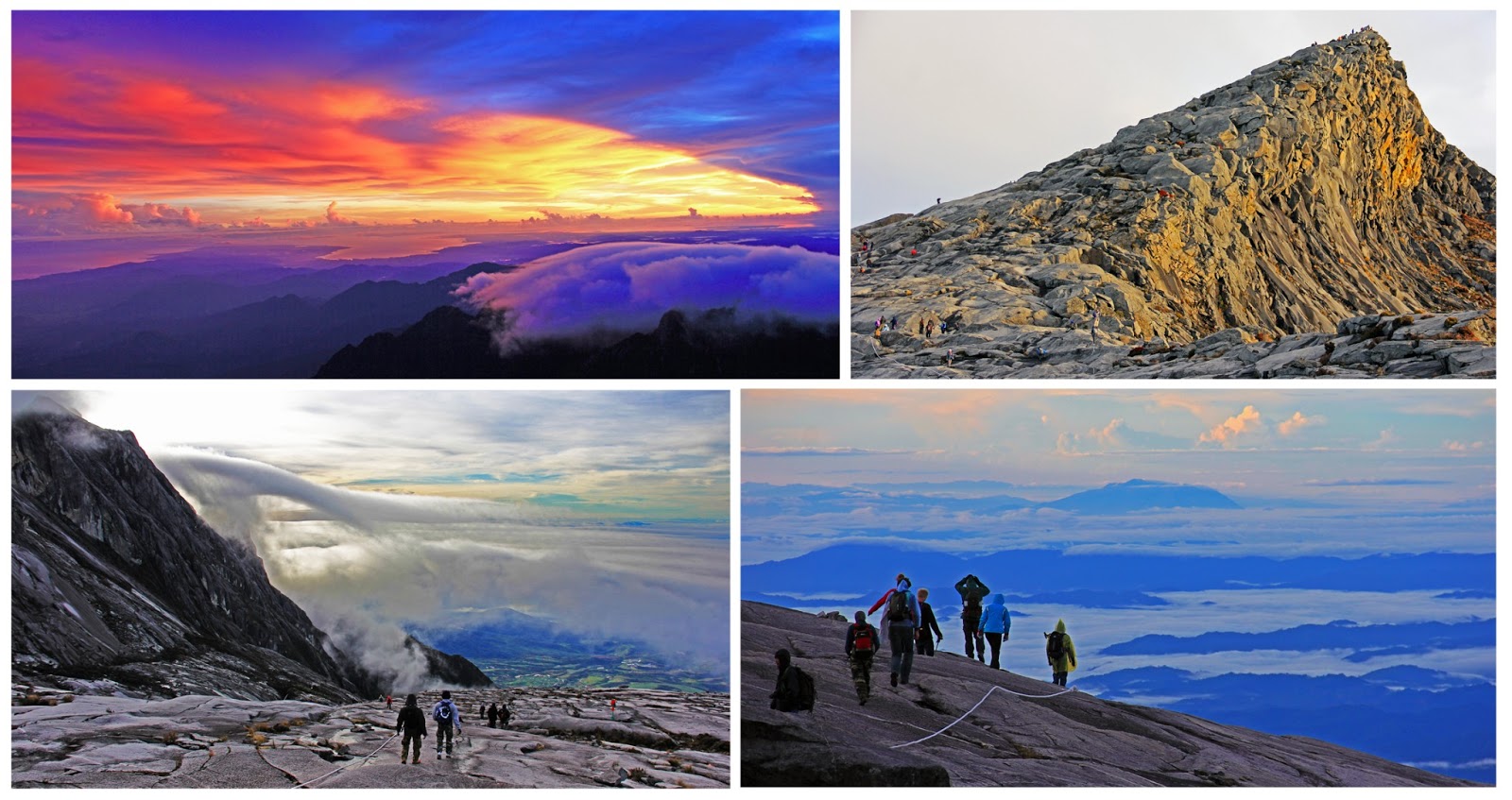
I’ve had my eye on Mount Kinabalu since I arrived in Borneo, literally. The entire northern tip of the island sits under his watch, with his colossal 13,435 foot peak dominating the vista for miles in every direction. Typically a morning person with a bold presence in the early hours, Mount Kinabalu tends to disappear under a blanket of clouds mid-morning and vanish into the horizon for the remainder of the day. He’s inconsistent and moody, and whether or not you’ll get to the top for a good view is a gamble considering his tumultuous relationship with Mother Nature. With only a couple of weeks left in Borneo, I had no choice but to try and conquer this almighty beast!

It was mid-week when I set out on the two-day trek, and since most of my friends had climbed the mountain already, I embarked on the journey alone. Well, Kinabalu National Park requires hiring a guide for the hike, so I had this little local man trailing me up the mountain the whole way. He didn’t speak much English, but was always there to provide an encouraging smile and a thumbs-up with every glance over my shoulder.

You can opt to hike the mountain in a day, but it’s best done broken up into two, since reaching the summit in the early morning will give you the best chances of having a view. And when I say ‘early morning’, I mean by sunrise. People start the second day of the hike around 2 o’clock in the morning and ascend the mountain with headlamps so they can be on the peak at daybreak. Laban Rata Guesthouse is perched on the mountainside just below 11,0000 feet, and provides meals and dorms for the mid-hike repose.

The trail was steep, and I realized quickly that there's no such thing as a switchback in Kinabalu National Park. The entire hike is a little over five miles in each direction, but the increase in elevation from the trailhead to the top is over 7,300 feet. As we started the hike my guide informed me that it would be a good five or six hours to Laban Rata, and I don’t know what got into me, but I was on a tear heading up the mountain! In just over two hours I was perched on the deck of the guesthouse drinking a beer and scarfing down a plate of mee goreng telur. Exhausted and full, I retired to my dorm for an afternoon doze and fell asleep to the sound of heavy rain on a tin roof.


The guesthouse was crowded when I awoke from my nap and the afternoon storm had come and gone. I spent the end of the day on an earthen terrace below the guesthouse and celebrated eventide by watching an endless parade of clouds march and morph through the sky. The residual vapor from the afternoon showers held a rainbow that seemed to bridge heaven and earth, and while the slope of the mountain obstructed the setting sun, the colors of dusk pushed through as the clouds below rolled over hilltops through a pink and orange light. I could see Kota Kinabalu and its outlying islands along the coast, and watched the twinkling city lights grow as daylight faded. With a long afternoon nap behind me and the growing anticipation of a summit sunrise, I was hardly ready for sleep, but with an alarm set for 2 a.m., I forced myself into an early bedtime.

It doesn’t matter if you’re close to the equator in the middle of summer, if you’re at 13,500 feet pre-dawn, it’s going to be pretty damn cold. After renting a jacket from the guesthouse, we set out in the middle of the night for the final leg of the ascent. The tree line broke soon after our departure, and our footsteps followed the wake of our headlamps as we scrambled up the rock face through the darkness. I was on par with my previous days pace, and made good time in reaching the summit a little before 5 a.m. The peak was small and awkward, and got progressively more crowded as dawn approached. Arriving early gave me the chance to stake out a good place for the sunrise, but trying to keep warm with over an hour until daybreak was challenging. By the time the sun started to peak over the horizon, I could barely feel my fingers enough to handle my camera.

We were blessed that morning with the perfect balance of clouds and clarity, and when the sun finally broke, the land was hit with an explosion of color. While the cloud cover above remained a static palette for the mutating shades of dawn, the opposing peak wore a tumbling billow that moved as though it were in a time-lapse. I could see for miles, all the way up to the tip of Borneo and out across the coastal islands. On so many mornings I’d gazed upon Mount Kinabalu from the shores of Mantanani, and now I was looking down on the island as a little speck in the South China Sea. It was an amazing sunrise. And I also gladly welcomed the warmth that it brought.


The hike back down to the guesthouse revealed over 2,000 vertical feet of beauty that had been covered in darkness just a few hours earlier. The collection of peaks that appeared saw-toothed from below were divided by sweeping moonscapes that rolled down towards a misty green earth. I took my time hiking down, and still reached the guesthouse before I usually get out of bed. After a quick rest and a small breakfast, I hit the trail again for the final leg of the descent, and reached the bottom mid-day on a wobbly pair of legs. I’d conquered Mount Kinabalu. Or maybe I’d become his friend. He did decide to give me a most excellent view, after all, and an experience that I’ll never forget.

Friday, July 13, 2012

MANTANANI MOONRISE


I was in Thailand a few years ago when I first realized that a full moon simultaneously rises with the setting sun. The astrological concurrence happened while I was on a rooftop in Bangkok with a great group of friends and a not-so-great bottle of tequila, and while I spun circles watching the two celestial bodies slowly trade places in the evening sky, I wondered why people don't consciously observe this stellar phenomenon more often. Ok, the world renowned Full Moon Party was about to pop off that night a few hundred miles south on Ko Pha Ngan, but that's more about drugs, neon paint, and fire dancing than actually enjoying the moon. Anyways, I'm talking about catching the two together, a sunset-moonrise.

I've seen quite a few moonrises in the past, but they were impromptu, and rarely in a place where I could also enjoy the sunset. So unexpected, in fact, that they would usually start with someone saying, "Whoa! Is that the moon?" One such occasion happened after work while I was living in San Francisco. My friend Davis and I were strolling through Chinatown on the way to North Beach, and as we crossed Broadway, we looked down past the neon lights and strip clubs to see a glowing moon rising up over the pavement. That's when we ditched the idea of going to a bar, grabbed a bottle of whiskey from a liquor store, and b-lined it to the top of Telegraph Hill, just in time to see the full moon crawl up into its cradle between the towers of the Bay Bridge and continue up into the stars. It was magnificent. But why wasn't the hilltop packed full of people?

The eastern tip of Mantanani Island is an ever-shifting thin strip of white sand that stretches out into a turquoise-blue sea. If you can get up early enough it's a great place to take in the sunrise, or in the evening, a moonrise. I was on the island in early June when I noticed a luminous luna in the night sky. I checked the internet to see if a full moon was approaching, and it was. So the next day I convinced a group of friends to head out to the eastern tip of the island for the moonrise-sunset. Damn weather! It was a cloud-covered bust. Don't get me wrong, it was an amazing place to experience the transition from day to night, but sans moon and sun, the fade into darkness was nothing but a gradual dimming of the heavens.


Luckily I was on Mantanani a month later for another full moon, and this time had the addition of an ideal forecast. That morning I hiked out to the tip of the island for the sunrise with my friends Yanti and Ramaesh. It was a tiresome daybreak trudge, but once we reached the eastern strand and saw the sun rising up over the sea, it was all worth it. I love kicking off the morning with a good sunrise! The weather was flawless that day, but in fear of a second botched attempt at a Mantanani sunset-moonrise, I hiked out to the tip of the island alone as evening approached. And, well, it would’ve been nice to share it with someone, but at the same time, it’s probably better that no one was around to hear me whoop and holler as the celestial show commenced. Mount Kinabalu, which is usually only visible in the early mornings, was popping off the horizon with acute detail. And as the sun disappeared over the island to west, the moon rose up in the east over the distant mainland, casting a pale reflection across the darkening turquoise.


My second sunset-moonrise was beautiful, and I will make an effort to see this monthly event more often. The next one happens in early August. I’ll be in Indonesia. And September, New York City...

Friday, June 22, 2012

WILD BORNEO


And he's also a tour guide! Yet another facet of Charlie's interesting and diverse livelihood - always up to something fun and crazy, now that's the way to live! In mid-June Charlie had a huge trip booked with a group of ten prosperous Americans, and it definitely wasn't your average week long adventure through Malaysian Borneo. For starters, the whole journey was carried out in a squadron of helicopters. Don't worry about the hike back down after we conquer Mount Kinabalu, we're gonna have the choppers pick us up at the top and take us straight to a beach resort for massages and a lobster dinner. Yeah bro, it was really like that. Way to rough it!

The week before this extravagantly meticulous excursion went down, Charlie was bopping around Borneo with a colleague, ironing out the details and making sure that everything fit according to plan. The expedition was to kick off on the east coast town of Sandakan and make it's way west, so Charlie asked me if I could come along on the last four days of the run-through in order to drive his car back to Kota Kinabalu after he embarked on the tour. 

The first stop on the expedited adventure was the Kinabatangan River. It was a long drive from Kota Kinabalu, and as we made our way east we entered the land of palm oil plantations. Palm oil plantations sure are pretty to drive through - rolling hills covered with manicured forests of fern-covered palm trees, but don't be fooled, they're horrible! Palm oil is a major cash crop, but the resulting deforestation leaves Borneo's abundant wildlife homeless, and is the reason why the Kinabatangan River Valley is overflowing with fauna - they have nowhere else go.

We stayed the night in a lodge on the river, and bookended our brief stopover with a couple of riverboat cruises, including an early morning jaunt where we caught an amazing sunrise over the jungle. Unfortunately we didn't spot any of the pygmy elephants that notoriously roam the riverbanks, but we did see a ton of other great wildlife, including the cartoonish proboscis monkey. These creatures are like caricatures of the primate family, especially the males with their big droopy noses and rotund bellies. And almost as a counter to their flaccid snouts, male proboscis monkeys romp around the jungle sporting perpetual erections. It's as though the end of each protrusion has attracting magnets that are constantly pulling at each other over their bulbous tummies. They must be the laughingstock of the jungle.

Our next stop was Danum Valley, a massive land conservancy with primary rainforest, bountiful wildlife, and a first-rate research center that attracts researchers and scientists from around the world. Oh yeah, and a stunning five-star resort with helicopter access. It was another long drive, mostly on a slow and muddy road, and by the time we arrived and checked things over with the resort, all we had time for was an awesome night trek through the jungle. I've been on a bunch of these with Charlie since I've been in Borneo, and the list of creatures that I've seen gets longer and longer with every hike. They are truly amazing! If only my nocturnal photography skills could do any justice.

The next morning we got up for our second sunrise in a row and took off for a hilltop observation tower overlooking the jungle. I've seen some great sunrises in my life, but I think this one might top the list. From the observation deck we sat perched above a sea of fog that blanketed the forest floor. Only the tallest trees in the canopy peeked out from below, and the hills and mountains that rose above the cloak of dawn looked like an emerald archipelago sprawled out over a white sea. As the sun came up over the horizon, the misty tide retreated, and the greenery of Danum Valley appeared to face the day. 


After breakfast we took off for Sandakan, and the next morning, after dropping Charlie off at the airport to meet his tour group, I hit the road for the long drive back to Kota Kinabalu. It had been a quick but memorable tour of northeastern Borneo. And while Charlie was heading out for the week to explore the region by helicopter, I was packing my bags for a quick trip to the Philippines...

Wednesday, June 20, 2012

BRIGHT AND STORMY


A return trip to Mantanani Island!

Amanda is from Kuala Lumpur but lives in England where she’s working on getting her masters degree in anthropology. Her summer research project brought her back home for a journey to Mantanani Island in order to gain some insight on the burgeoning tourism industry and it’s effects on the local population. My friend Jess recently started working for an NGO that is planning some projects on Mantanani, and since Amanda’s research lines up with their interests, they decided to work together and sponsor her trip to the island. Where do I fit in? Well, apparently Amanda’s parents didn’t feel too comfortable with her being on the island alone, so Jess asked me if I wanted to spend a week there and keep her company while she did her research. Twist my arm.

Unlike the glassy cruise that I had on my first trip to a hot and sunny Mantanani, the boat ride bounced along over choppy seas, dark clouds hovered above, and we arrived on a damp island that had just soaked up a morning shower. I stayed on the island for a week, and the stormy weather ended up being par for the course throughout my visit. Mantanani? More like Manta-nasty! Not really. While the weather could’ve been better, I soon realized that even the darkest storm couldn’t blemish this island paradise, and the beauty that revealed itself under the circumstances made me fall for this little gem in the South China Sea even more. While still vibrant, the normally smooth turquoise and blue striated water was a shade darker and spotted with white caps. And with the ever-shifting ominous clouds overhead, the banded breakers progressed above the horizon into layers of striped stratus, adding an extensive range of grays and blues to the celestial landscape.


Amanda and I stayed in a little stilted house on the outskirts of the village, a stones throw from the sea, surrounded by gentle palm trees and friendly neighbors. It was a wonderful backdrop for a week on the island, and on top of the natural beauty, a new side of Mantanani’s charm became apparent during my stay. I’d already walked most of the island, and had strolled through the village a number of times on my last visit, but being immersed in the tight-knit fishing community added an ethnographic richness that I hadn't experienced before. Whether it was watching life unfold from the front porch on a windy morning, sharing meals with the neighbors, or being transformed into a human jungle gym by the local kids, my sojourn revealed a Mantanani that most visitors don’t get to see. But I guess that’s what happens when you hang out with an anthropologist.

Sunday, June 10, 2012

THE SAMSUNG GOAT™


I thought it was a joke at first, but then I remembered where I was... and it still didn’t make sense.

The rice harvest is celebrated in small villages all across the State of Sabah throughout the month of May, with the last two days marked as a public holiday called Kaamatan, or the Harvest Festival. In Kota Kinabalu they hold a two day event at the fairgrounds on the outskirts of town, with singing, dancing, eating, drinking, and cultural festivities aplenty, and with over thirty different ethnic groups in the region, the festival is full of unique cultural traditions. The fair was an ethnographic delight, but surprisingly, one of the more enlightening moments occurred when I noticed a series of banners hanging up around the beer tents. Carlsberg was sponsoring a raffle - buy three beers and you could enter to win some prizes. And while Samsung was supplying the loot for the runners-up, the grand prize winner was to receive... a live goat!

I don’t know why, but this totally blew me away. I’ve always enjoyed checking out advertising when I travel as a way of gaining geographical insight, but this little piece of marketing had me asking all sorts of questions about where I was in the world. I think mostly because (except for the fact that I’m not from Borneo) I’m probably a pretty good fit for the target demographic. It’s interesting to think about the market research that must have gone into this contest. New technology seems to have a universal appeal these days, but how did winning a live goat reveal itself as the ultimate draw? And I wonder what the people at Samsung thought about their latest and greatest smartphone coming in second behind some time-honored livestock? I can just imagine how the conversation went...

Carl: “Thanks for partnering with us on this give-away, but do you think you could also throw in a live goat? The grand prize really needs to hit home with these guys and your smartphones just aren’t cutting it.”

Sam: “Uh, wow. Don’t you think we should stick to one category for the prizes?

Carl: “Yeah, well it’s either that, or the runner-up gets a brood of chickens.”

Sam: “Ok, fine. We’ll throw in a live goat, but do you think it would be possible to brand it with a Samsung logo? And we’ll really need to push the fact that it can double as a garbage disposal...”

Who knows if this contest appealed to its target demographic, or if it was a botched marketing ploy, but either way it was a perfect example of why I love to travel - it’s the littlest things sometimes that put my experiences into perspective, and make me realize that I’m not in Kansas anymore...

Monday, May 28, 2012

LUPA MASA


Forget time - that’s what lupa masa means in Malay. And when Charlie and his friend Tom built their out-of-the-way jungle camp in some primary rainforest on the outskirts of Kinabalu National Park, that’s exactly what they had in mind. Its remote location results in sporadic visits, but adventurous travelers that are up for the diversion are rewarded with a rustic get-away in the middle of a fairytale forest. It’s a half hour hike to the camp from the village of Poring, and by the time you arrive, chances are you’ll be wet and muddy from the knees down - it’s a great segue to Lupa Masa, and the perfect introduction to the backdrop for your stay in the jungle. The camp rests on three hectares of land, pinched in between two conjoining rivers and the national park boundary. As of now Lupa Masa consists of a few open-air bungalows, some basic bathroom facilities, and a big kitchen-tent with an adjoining sun-deck, all of which are constructed mostly of bamboo. The rivers are absolutely stunning, and both come tumbling down the jungly slopes with more than enough force to provide Lupa Masa with its hydroelectric power and water supply. I’d also say the rivers are largely responsible for Lupa Masa’s name. If there’s one thing that really causes you to ‘forget time’, it’s letting yourself become absorbed in the pure jungle current. The sound of the cascading water along with the hum of the rainforest will leave you in an aural utopia, and finding a warm boulder to lie on after a refreshing dip in the river will have you wishing you could press a pause button.

Charlie and Tom are very busy dudes. Lupa Masa is just one of a handful of projects that they’re involved with, and since it’s a good two or three hour drive from Kota Kinabalu, a young local guy named Libot manages the camp while they’re not around. Lupa Masa also takes volunteers, and more often than not there’s a traveler or two up there for an extended stay - helping out around the camp and getting to know a unique corner of the world. That’s where I fit in. I’ve spent a lot of ‘forgotten’ time in Lupa Masa over the last month, meeting guests in the village for the hike up to the camp, helping Libot cook, and lending a hand with daily upkeep. It's been a lot of fun, and I've come to feel pretty comfortable in the jungle. But alas, in a couple of months I'll be moving to a different kind of jungle, a concrete jungle! And I'm sure that'll be fun too.

The hydroelectric power generated at Lupa Masa starts with the little dam on the left which funnels water downstream through a series of pipes. The little shack pictured in the middle, houses the micro-hydro turbine pictured on the right, which provides up to 300 watts of free and sustainable power to the camp!

Tuesday, May 15, 2012

MANTANANI


From a lush primary rainforest one week, to a tropical island paradise the next! Borneo is awesome! Charlie recently moved into a spacious new apartment in Kota Kinabalu and needed to fill it with some furniture. Being the crafty handyman that he is, he decided that he’d build his own, and started by lugging a chainsaw out to the island of Mantanani to carve up some of its bountiful driftwood. It was Charlie’s first visit to the island, but his girlfriend Jess, who is a freelance dive instructor, has spent a lot of time there for work. She also lived there for a year and helped start a backpackers lodge, so she’s quite familiar with the island. Our friend Yanti also came along. She works for an organization that runs a camp on Mantanani which puts up volunteers and organizes community projects. And our friend Anna was already there, working at Yanti’s camp to help construct new bungalows for the volunteers.

It was an hour-long boat ride to Mantanani, and the four of us sat side-by-side with our feet dangling over the front of the ferry. The ocean was glassy that morning, and as we glided in towards the island the water transformed into a dreamy turquoise-blue. It’s a tough commute if you’re a freelance dive instructor like Jess. The boat dropped us off on a white-sand beach at one of the dive camps where Jess works, and after a splash in the water, Jess’s dive buddies fed us a tasty lunch and lent us some gear for an afternoon snorkel. In between bouts of water-play, we relaxed in the array of hammocks that were strung up around the beach. On the way in Yanti warned me that Mantanani was conducive to napping, and once I started swaying to and fro in the warm ocean breeze and felt my eyelids grow heavy with content, I understood exactly what she meant. From hammock to water, back and forth. I ended up doing a lot of swimming and swinging over the next few days. And napping too.


There’s a jungly, precipitous hill on the northwestern tip of Mantanani, and if it weren’t impassable, you could probably walk around the island in less than two hours. The simple network of sandy paths are utilized only by foot and bicycle (no cars!), and if you’re feeling lazy, catching a lift around the island on a tiny fishing boat can be easily arranged. There’s a small village along the south-eastern shore, and another cluster of stilted homes a little farther west, and whoever the local housepainter is must have the most colorful work clothes around. Only a vibrant backdrop like the tropical paradise of Mantanani could host such radiant houses without appearing too gaudy. It’s very fitting. And the people are equally colorful. With an abundance of cheerful kids, and an all-around small-town courteousness, life on the island is easygoing and warm like the breeze. While I tested out different hammocks and worked on my tan, Charlie put his chainsaw to use. And after a few days we hired a fishing boat to take us back to the mainland with a bundle of carved-up driftwood that would soon be furniture. Mantanani was amazing, but it was time for me to head back to the jungle and lupa masa...

Wednesday, May 9, 2012

THE PENAN

My journey from China to Borneo, and the quest to find my friend Charlie, came to an end when we reunited on the banks of the Bejelai River in the tiny village of Long Ajeng. But reaching Charlie wasn’t easy. In fact, I’ve never been to such a remote place in my entire life. Charlie was out in the jungle when I arrived in Kota Kinabalu, and instead of waiting for him to return, I pieced together the few clues that he left me, and made my way deep into the rainforest to find him.

Charlie volunteers with a small organization that coordinates community projects with the Penan. There are only a few thousand of these historically nomadic hunter-gatherers left in the world, and only a couple hundred that still live in the forest and maintain their traditional lifestyle. Most Penan have left the jungles to find work in the cities, leaving behind a dwindling population that not only struggles for cultural survival, but is also forced to confront the irrepressible logging industry which continues to rapidly shrink their natural habitat. The projects Charlie collaborates on are part of a five village cooperative run by the Penan that directly contributes to their community. Getting to a Penan village is no easy task, but for those who are interested, Charlie can act as a liaison for the cultural exchange, organizing home-stays, jungle treks, and re-forestation projects. Because of its inaccessibility, this kind of ‘tourism’ isn’t very popular; the last foreigner to visit the village where we stayed was Charlie, and that was almost six months ago.

My quest to find Charlie started with a twelve hour bus ride along the northern coast of Borneo to the town of Miri. The next morning I met up with Charlie’s friends Sarah and Manitre, and a young British couple, Simon and Emma, and the five of us boarded an airplane for the forty-five minute flight to Long Akah. We were all searching for Charlie, but no one knew exactly where to find him. The twin-prop airplane was tiny, and the loud and bumpy flight through the clouds had me humming the Indiana Jones theme song and feeling excited for the upcoming adventure. The airport in Long Akah was basic to say the least - little more than a landing strip in the jungle - and since there was no electricity or computers, we casually signed up in a notebook for the next flight back to Miri in five days time. Charlie’s friend Ken picked us up in his truck for the next portion of our trip, a bumpy meander through the forest on a dirt logging road. Traffic was light except for the procession of ominous logging trucks that rumbled along, kicking up dust as they pulled the forest apart little by little. After an hour and a half Ken dropped us off by a small make-shift shelter and pointed us down an overgrown trail into the jungle. It was the last time we’d use a road for five days. "There’s a village thirty minutes that way." "Is that where Charlie is?" "I don’t know..."  

Sarah and Manitre were along on the adventure to initiate a collaborative project with the Penan. Sarah’s architecture firm is planning a summer workshop where students will spend a month working with the Penan to conceptualize and build a pondok in the forest. A pondok is an elevated jungle shelter, usually small and semi-permanent, used as a resting place while out on hunting excursions. The plan for the collaboration is to create a larger permanent structure that the Penan can use while hunting, but that can also double as a base-camp for tourist jungle treks. Manitre is Penan, but lives in Kota Kinabalu, and came along to translate and help Sarah facilitate discussions about the endeavor.

After a sweaty forty-five minute hike, the trail bumped into a river, across which sat the village of Long Laman. Luckily there were a few villagers hanging out on the opposite bank, and before long they came floating over in a boat to retrieve us. There’s no cell phone service in the jungle, and communication is sparse, but when there’s a muscular six-foot-two bald dude with tattoos in the vicinity, people tend to have an idea of where he is. We caught word that Charlie was an hour and a half away in Long Ajeng, so after a round of tea with the villagers, we boarded some wooden boats for the final leg of our journey. After a brief float down-stream, we hit a fork in the river and turned into the current, finishing our boat trip with sporadic wading and an occasional walk through the shallows. It was mid-afternoon when we finally reached the village, and just as we’d heard, Charlie was there with his girlfriend Jess. With a spattering of stilted huts and a host of smiling villagers, Long Ajeng welcomed us with charm and repose after our lengthy trip.

Top-left: Getting ready to hike in and find Charlie. A few days later we'd be at the base of the three mountains in the background. Top-right: The villagers of Long Ajeng seeing us off before our jungle trek. Bottom-left: Yesiah weaving a fishing a net. Middle-left: The modest stilted home of Yawa - the village head of Long Ajeng. Middle-right: A village elder working on a new blowgun. Bottom-right: The longhouse in Long Ajeng.
Around fifty years ago, due to government control and the introduction of Christian missionaries, the nomadic Penan were coaxed into a more settled lifestyle. In the tradition of their more rooted indigenous neighbors, the Penan built their riverside villages around a communal longhouse - a primitive apartment building with separate units that branch off of a shared space. Since most of the villagers still spend months on end out in the jungle, the longhouse in Long Ajeng was largely vacant, leaving plenty of space for us to stay. Upon arrival I was shown to a dark second-floor room and given a simple bamboo mat to sleep on. After putting down our bags we went back to the river for a swim and splashed around in the water for the remainder of the day, outlasting an afternoon rainstorm that blew over the forest. The evening commenced with a large meal that rolled into a multi-village gathering to discuss Sarah’s proposal. The generator was turned on in an attempt to provide the get-together with some light, only to putter out five minutes later and leave everyone to their usual headlamps and flashlights. Three different village heads were present, along with a crowd of curious villagers, and all those attending seemed enthusiastic about the collaboration. The next day we left the village to explore the jungle and to scout out an ideal location for the project.

Jawa, the village head of Long Ajeng, led us into the jungle the next morning along with two other young men, Roger and Tisun. A half hour into our trek we were joined by two more neighboring village leaders, bringing our caravan to a total of twelve. All three village leaders trekked with their knife-tipped blowguns in hand and a quiver of lethal darts next to the machete on their hips. The blowgun is the preferred weapon for hunting, and the Penan use it to shoot and kill everything from birds to monkeys to wild boars. The tree sap they use to poison the darts is highly lethal, and is easily strong enough to kill a human. Jawa wore the traditional bowl-cut style hairdo and his earlobes were droopy from the customary weighted jewelry. He glided along with a calmness and confidence that could only come with the deepest knowledge of the rainforest. The barrage of greenery was like a familiar story; the foliage like the pages of a book he’d read a million times. He was in his element, and I was totally out of mine.  

Five hours later we reached the prospective project site, and after a short rest we went about setting up camp. On a flat spot at the bottom of a steep hill, right next to a beautiful clear jungle stream, sat an old pondok, and while our Penan guides worked on re-constructing the tattered lean-to, the rest of us searched for an ideal spot to hang our camping hammocks, eventually settling on a cluster of a trees across the creek. Not long after we set up camp, a downpour came along and sent the twelve of us huddling under the tarps of the cleverly constructed new pondok. At one point we heard a soft rumble and looked up to see a torrent of brown water come crashing down the gentle stream. Within seconds the once ankle-deep creek had transformed into a dirty waist-high river! The rain lasted for a couple of hours, but even after it stopped, the forest continued to drip and glisten in the late day sun. 

Left: The make-shift pondok at the jungle campsite. Middle-left: Jawa's woven backpack, his blowgun, and a quiver of poisonous darts.  Middle-right: Charlie wades across the flooded stream. Our camping hammocks are strung across the trees in the background. Right: Looking up at the mountain before climbing up to the lookout.
For dinner we had a light fish stew with rice, and a few hours after dark Roger and Tisun invited us on their hunt for the next day's breakfast. Roger had been quiet on the hike in, and had lagged behind and had gone mostly unnoticed. But that night he came out of his shell. With our jungle boots and headlamps we waded into the water and followed our guides upstream, Tisun carrying a fishing net and Roger wielding a blowgun with a quiver of darts. Roger’s stealthy nocturnal agility was awe-inspiring. As I tried my hardest to keep up, clumsily splashing through the current and slipping about on the aqua-terrain, Roger cruised along barefoot, side-stepping through the darkness in a crouched position, cutting back and forth from bank to bank with blowgun in hand. Using the flat side of the double-edged knife on his blowgun, he would sneak up on heedless frogs and bring their life to an end with an explosive whack, then scramble up a steep riverbank and blow a dart into a sleeping bird on a tree branch, sending a poof of feathers into the beam of his headlamp, and a lanced bird into the water below. It was ridiculous how easy he made it look, and how absolutely clumsy the rest of us were as we tried to keep up with him. Tisun was right by his side, unfurling the weighted fishing net into dark pools of water and pulling out a tangle of small fish and river eels. The two of them terrorized little night creatures all up and down the river, at least the ones that weren’t scared off by the awkward and clamorous gang that followed. And of course we had plenty of food for breakfast the next morning.

Sarah’s reconnaissance of the area was favorable and the spot seemed ideal for the upcoming project, so the next day after a fried fish and frog breakfast we broke down the camp and wandered back into the jungle. The plan was to head to the village of Long Marung, but not before exploring some caves and hiking to a lookout. After an hour or so we dropped our bags, covered them with a tarp on the forest floor, and took off to do some spelunking. Roger and Tisun took the lead from there and right away had us bushwhacking through thick undergrowth. I stumbled along behind them, sweating bullets and trying not lose my footing as we ascended muddy slopes and scaled rotting logs. We entered a bat-filled cave at the bottom of a steep ravine, and I was immediately overwhelmed by a sense of claustrophobia. The cave was tiny and damp, and within two minutes I’d been slapped in the face by an unruly bat. We squeezed our way through small tunnels, grinding against slimy rocks, and trying at all costs to avoid the gargantuan poisonous millipedes that clung to the walls. Fortunately, it was a rather brief and anti-climactic exploration, and after twenty minutes I resurfaced covered in guano and feeling a little freaked out. After scarfing down some leftover rice for lunch, we took off for the lookout. 

A few days earlier, when Charlie’s friend Ken had dropped us off on the logging road at the start of our trek, he pointed out three side-by-side karstic mountains rising out of the faraway jungle. The lookout was perched near the base of one of these triplets, and reaching it required climbing up vines and rocks to a shelf about seventy-five feet above the jungle floor. Tisun boldly hung out over the ledge and cleared some foliage with his machete, revealing one of the neighboring peaks and a partial view of the forest below, along with a quickly approaching raincloud. It wasn’t long after we left the lookout that we got caught in a torrential downpour. We were drenched by the time we got back to our tarp-covered bags, and while most of them were dry, they were all covered in an army of fire ants. I threw my backpack on under my poncho, only to realize that I’d trapped a few inside. Ouch.

After three stormy hours, it was decided that visiting Long Marung would be too difficult. The probable swelling of a large river that we’d have to cross would be too risky. Instead we decided to head back to Long Ajeng; it was a longer trek, but a safer bet. The rain was unrelenting, and the harder it fell, the weaker I got. I’d started that morning with a small blister on the side of my right ankle from my new jungle boots, and while it was nothing but a light abrasion, it was enough for me to fall victim to the bacterial breeding ground of the rainforest and the onset of a nasty infection. By the time we stumbled back into Long Ajeng it was almost nightfall and I was running a fever. After a quick rinse in the river, I climbed up to my second-floor room in the longhouse and collapsed into a febrile thirteen hour sleep. The jungle had taken it’s toll.

I felt better the next morning, and although my fever had subsided, the infection had started to spread into the rest of my foot. Relaxing in the village wasn’t going to remedy the situation, but that was all I could do until our journey out the next day. And so after an easy day of swimming, eating, and hanging out with the villagers of Long Ajeng, we retraced our steps out of the jungle and made our way back to Kota Kinabalu. My foot was starting to swell, but it was nothing that a heavy course of antibiotics couldn’t fix. And for me, it was well worth the adventure! I’d only been in Borneo for seven days, and it had already been one of the most memorable weeks of my life. I’ve got a few months left in this part of the world, and a return visit with the Penan is already in the works...

Friday, April 13, 2012

KOTA KINABALU


Here I am, in Kota Kinabalu, Malaysia, on the northeastern tip of the island of Borneo - this is where I'll be based out of for the next three of four months. Not bad! After my teaching job in China fell through, my friend Charlie was nice enough to give me a job here for the summer. He happens to be out in the jungle right now, so in a couple of days I'll be jumping on a bush plane to head out and try and find him. Wish me luck. Traveling around and sightseeing is good fun, but it's time to put my bag down for a while and get to know a place. Anyways, to quote Willie Nelson, still is still moving to me...

Tuesday, May 19, 2009

LANGKAWI SUNSET


The country road I was on hit the coast as the sun sat low in the sky. I had heard that the beaches on the northern part of the island were the most beautiful in all of Langkawi, it was true. I spent the end of the day on the beach and then made my way back to the guesthouse in the dark. Tomorrow I would catch a ferry back to Thailand...

ISLAND SOCCER MATCH


I left Seven Wells Waterfall and took off across the island on my motorbike. It was a great ride, I enjoyed seeing the island countryside. I passed a soccer game along the way and decided to turn around and watch it for a while. The field looked like it had been carved out of the jungle, it was surrounded by dense vegetation and sat at the bottom of a steep hill. There were quite a few spectators lining the field, and as I stopped to watch the game, everyone there stopped to watch me. Even the guys playing stopped, one of the them almost took off his jersey and offered it to me. Play on? I found a place to stand on the sideline and watched the game for while. I was getting a lot of smiles from people and a lot of giggles from the kids that were there. The game was fun, I guess they were two rival villages, everyone was having a good time. It was getting kind of late in the day and I wanted to find these beaches on the northern part of the island to watch the sunset, so I decided to leave. I thought my entrance was embarrassing, my exit was even worse. Pulling out onto the road from where the soccer field was I hit some sand on my motorbike and totally wiped out. I wasn't going fast, and I just kind of clumsily fell over, but of course the game stopped again. I quickly stood up, all red in the face, and gave a sheepish grin and a thumbs up to all the shocked faces that were looking at me. A few guys ran over and I had to reassure them that I was ok. They were very nice, if I were them I would've been laughing at me. The game carried on and I made my way back down the road...

HERE I AM


This sign is awesome. When I saw this I thought to myself, "Here I am...". There was no context to this sign, no map or anything, it was just stuck in the ground next to this trailhead. There couldn't be a more accurate sign...

SEVEN WELLS WATERFALL


My next stop was just down the road from the Langkawi Cable Car. The Seven Wells Waterfall is named so because of a series of little pools that have formed in the rocks. The rocks are slippery and smooth and you can slide down the waterfall from pool to pool. Once I got up to the pools I noticed that there were signs for some trails through the jungle, so before going for a dip in the waterfall I thought I would go for a little hike. The jungle was thick and hot, and all of those dark storm clouds that I saw from the top of the gondola began to make there way overhead. After a half hour or so the rain began to fall, and it fell hard, more like a downpour. I took my shirt off and wrapped it around my camera case for extra protection from the water. It was kind of weird being in the jungle alone in the rain, I passed a few people towards the beginning of my hike, but hadn't seen anyone else along the way. The trail began to get really steep around the same time that the rain began to fall, ropes were tied from tree to tree so you could help pull yourself up the path. I was wearing flip flops, and when the trail began to fill with water and turn into a little stream, the hiking became rather treacherous. I can't say I was really worried at the time, but if anything had happened to me I probably would've been screwed. I kept on hiking up, the jungle was dark in the rainstorm, but I kept on going. After a while the trail opened up into a clearing, a waterfall sliced through the jungle. I scrambled across some rocks and waded through the water over to a boulder that was perched in the middle of the river. Standing up on the rock I could look down the ravine, over the jungle, and out to the sea. I was overwhelmed with a burst of energy and excitement. I stood in the rain, beat my chest like Tarzan, and hollered like a frat boy. I felt alive! 

The view from the boulder changed after the sun came out, the sheets of rain added a sense of depth to the jungle that was lost in the sunshine. But when the sun came out the foliage in the jungle began to sparkle and glimmer in the sunlight. Holy shit. I don't even know, it was just awesome. The trail continued up, but I decided to head back down. I got back down to the pools, picked a few leaches of my feet (gross), and went for a dip. It wasn't that late yet and I still had a lot of the island to explore...

THE SKYBRIDGE


A short distance from the top of the gondola was this pretty spectacular skybridge. I walked across it, snapped a bunch of pictures, and then found a little path that led down to the ravine below. It was a very cool piece of architecture, and provided wonderful views of the island.

THE LANGKAWI CABLE CAR


The next day I rented a motorbike, what a great idea. As soon as I left Cenang Beach I was in the country side, zipping down the road with the ocean off to my left and rice paddies off to my right. There's nothing like the color of a rice paddy, I think that 'rice paddy green' has to be one of the most vibrant and beautiful colors in the world. My first stop of the day was at the Langkawi Cable Car, a gondola that runs up to the top of a mountain with beautiful views of the island. There were dark storm clouds hovering over the east side of the island that were slowly making there way across the land, it was very pretty. And a short hike away was a skybridge...

LANGKAWI ISLAND


I left Penang for Langkawi Island on an 8:15 AM ferry and arrived a little before noon. Langkawi is on the very north western coast of Malaysia, very close to Thailand. It's a pretty big island with some mountains, a lot of nice beaches, and not very many big towns. Once I got there I took off for Cenang Beach, a little beach along the west side of the island with some cheap places to stay. I found a little guesthouse just a stones throw from the beach and checked in for the night. The beach was nice, there weren't many people out, I went for a long swim and then wandered down the beach for a ways. Right on the beach just down from my guesthouse was Cenang Beach's reggae bar, called Babylon. A reggae bar called Babylon? Nice try. Being that 'Babylon' in Rasta terms refers to all bad things in society, the oppressor, corruption, basically 'the man'... I'm not quite sure it's the best choice of names for a reggae bar. But whatever, I still hung out there and drank beers. The beach, which was pretty empty during the day, began to fill up with people as the evening approached and the daytime heat began to fade. All of the sunbathing western tourists left the beach and the Malaysian tourists came out to enjoy the evening weather. I had an early night that night, the next day I was going to explore the island...

Monday, May 18, 2009

PENANG


Penang is an island off the west coast of Malaysia. The bus I was on crossed the bridge to Penang as the sun was setting over the island, it was beautiful. I found a place to stay in Georgetown, the biggest town on the island, on Chulia Street, in the old Chinatown. There's a lot of old pre-war British Colonial architecture in that part of the city, the buildings are all very weathered and textured. There are also a bunch of cheap places to stay for budget travelers like myself.

If there is one thing I will never forget about Penang, it's the food. Holy shit was it delicious. My first night in Penang I found a bunch of little food carts just down the block from where I was staying. During the day that section of the road is where all the hardware stores are, but at night after the shops close down, the food vendors roll up and set up their carts. I didn't know where to begin, I wanted to try everything. In my two nights there I think I ate from at least seven of the food carts. I went to bed both nights so stuffed that it hurt. Stir fried glass noodles with shrimp, fresh squeezed mango and coconut juice, chicken satay... I didn't even know what I was ordering most of the time. One of the stands was full of skewers, a couple pots of boiling water to cook/heat the skewers, and three or four sauces to dip the skewers into. I wanted to hang out there all night, but unfortunately it was my last stop of the evening and I was already so stuffed that I could only eat like seven or eight of 'em. My god did it taste good... If I lived in Penang I would be fat. Oh, and the breakfast I had on my first morning, I will never forget it for the rest of my life. I wandered into Little India to find some roti canai, a traditional Malaysian food that's like a sweet flatbread pancake thingy. I'd had it before, they sell it from little food carts in Thailand, but I wanted to try it while I was in Malaysia. It's kind of hard to describe, but they take a little ball of dough, flatten it out and twirl it until it's basically translucent, and then throw it onto the griddle. You can put all sorts of stuff in it, sometimes I get it with banana and coconut. Then they fold it over, flip it a few times, and serve it up, sometimes with sweetened condensed milk on top. Mmmm. So I ordered it for breakfast with egg and banana, two of 'em. It was tasty. But the best part was the metal bucket full of curry that they gave me. I shared it with the other people at my table so I guess it was like a condiment or something, but man did it make the meal. It was like a yellow potato curry, I could've just eaten that alone, but on top of the roti canai... whoa! I could've stayed there and eaten that all day, but I had to go meet up with Johnny Ho.

Johnny Ho is a brother of a family friend. Through a last minute correspondence initiated by my dad, I somehow arranged to meet up with him for the afternoon while I was in Penang. Johnny picked me up at the 7 Eleven on Chulia Street in his Benzo, he was playing Peter Cetera on the stereo, The Glory Of Love, what a great song. "So, uh, you showed my dad and brother around Penang when they came here 10 years ago?", I asked. "Um... yeah, I don't remember, maybe...?", he replied. I don't think he had any idea who I was. We drove around to the northern part of the island to a beach town called Batu Ferringhi, we didn't really have much to talk about, he pointed things out to me along the way. We found a little bar on the beach and ordered some lunch and a few beers. After a few drinks we both loosened up a bit and talked about all sorts of things. Johnny loves Penang, he is very proud to live there. "Look at this", he said, "Here we are on the beach at noon drinking beers. This is the life...". I agreed. Johnny and I hung out for the afternoon, he drove me around to some other places, we stopped for some more beers and talked and laughed, it was a good day. The next day I would catch the ferry to Langkawi...